NVIDIA’s Jetson Edge AI Platform Helps SMU Students Build Tiny Supercomputer for AI Research
November 07, 2022
News
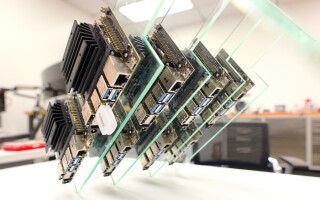
Built from scratch by Southern Methodist University students in Dallas, a DIY, aka do-it-yourself, supercomputer using NVIDIA’s Jetson Nano modules is helping provide the hands-on experience students may not receive with a standard supercomputer, which is often too large for a typical university learning environment.
Conner Ozenne, senior computer science major and STAR— a Student Technology Associate in Residence at SMU, originally pitched the project, “baby supercomputer” which consists of 16 NVIDIA Jetson Nano modules, four power supplies, over 60 handmade wires, a network switch, and cooling fans. These components have been combined to create the NVIDIA DGX SuperPOD supercomputer research system.
The research system features 160 NVIDIA A100 Tensor Core GPUs, is designed for cluster computing, and is capable of running and training artificial intelligence (AI) and machine learning (ML) models, but small enough for individual learning purposes. The development can fit on a desk and is equipped with a touchscreen display and dashboard that provides insight to the nodes and their status.
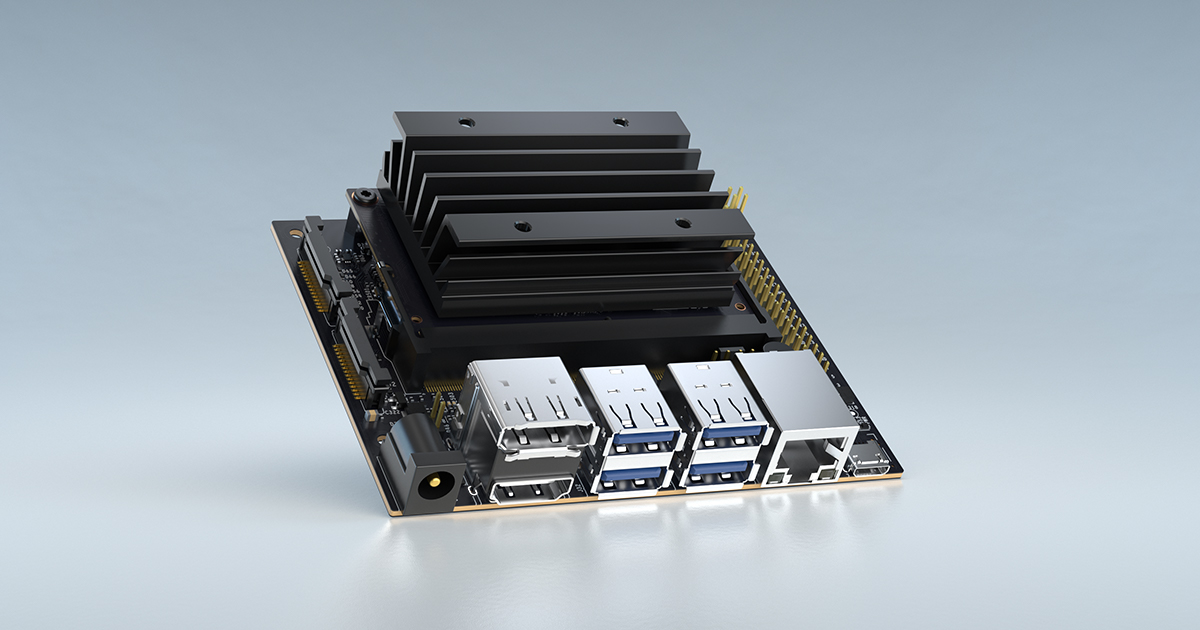
“We chose to use NVIDIA Jetson modules because no other small compute devices have onboard GPUs, which would let us tackle more AI and machine learning problems,” said Ozenne.
The team is lead by SMU’s Office of Information Technology Research and Data Sciences Services and director of its Student Technology Assistant in Residence (STAR) Program, Eric Godat, who further explains that the minicomputer will help test the machine learning models of the students who plan to utilize it.
Using the NVIDIA JetPack software development kit, the SMU team is now working on developing the baby supercomputers’ software stack, and they’re also collaborating with the NVIDIA DGX team to eventually help configure the research system to support a variety of AI, machine learning, data processing, and HPC projects.
“Our student team already has access to a really powerful supercomputer on campus, but having this miniature version gives them a chance to administer their own supercomputer, which is a novel experience,” said Godat.
The initial version of the cluster supercomputer has since received a few upgrades from its cardboard heatsinks and entangling wires connecting the NVIDIA Jetson Nano developer kits, and is now fitted inside an airtight 14 x 14 x 16-inch transparent acrylic housing.
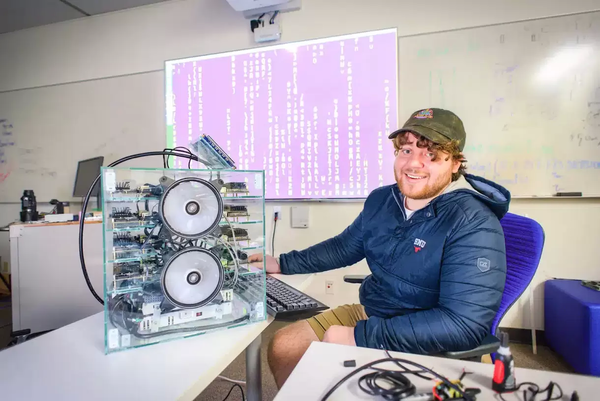
Conner Ozenne seated with what was once just pitched idea and a budgeted project to now a small-scale computer capable of handling data and patterns for training AI and ML models. (Image courtesy of https://blogs.nvidia.com/blog/2022/11/07/smu-tiny-supercomputer/ and https://www.smu.edu/stories/thinking-inside-the-box)
The SMU team is now benchmarking the system and prepping it for display at the SC22 supercomputing conference in Dallas this year. See the new DGX SuperPOD in action and speak with the SMU team at their booth, #3834.

Tiera Oliver is the assistant managing editor at Embedded Computing Design. She is responsible for web content editing, product news, and story development. She also manages, edits, and develops content for ECD podcasts, including Embedded Insiders.
She utilizes her expertise in journalism and content management to oversee editorial content, coordinate with editors, and ensure high-quality output across web, print, and multimedia platforms. She manages diverse projects, assists in the production of digital magazines, and hosts company podcasts by conducting in-depth interviews with industry leaders to deliver engaging and insightful discussions.
Tiera attended Northern Arizona University, where she received her bachelor's in journalism and political science. She was also a news reporter for the student-led newspaper, The Lumberjack.